What Is a Bond? How It Works, Returns, and Risks
Understand bonds with a simple example: how interest and maturity work, why prices change, and how a fixed coupon can still leave you with a loss.
Information checked October 29, 2026. Dollar examples are hypothetical, not current market offers. The basic explanation applies broadly; Treasury products and tax treatment below are US-specific.
How a bond works
Governments and companies issue bonds to borrow money. The borrower is the issuer; the investor who owns the bond is the bondholder. Unlike a stock, which represents ownership, a bond represents debt. Its terms set out the payments the issuer owes. FINRA’s bond guide explains these obligations and the risks of nonpayment.
Investors can use scheduled bond payments to plan income and hold bonds alongside stocks to diversify a portfolio. That does not make every bond low-risk or prevent investment losses.
You can buy a bond when it is first issued or buy an existing bond from another investor. In that second case, your purchase money goes to the seller, not directly to the issuer, and you acquire the right to the bond’s remaining payments.
For a conventional fixed-rate bond, three terms explain most of the payment schedule:
- Face value, or par value: the amount the issuer promises to repay at maturity. It may differ from your purchase price.
- Coupon rate: the annual interest rate applied to face value. A fixed-rate bond keeps this rate even as its market price changes.
- Maturity date: the date the issuer is scheduled to repay face value, usually with the final interest payment.
These are promises under the bond’s terms, not a guarantee that every issuer will pay. Some bonds also allow early repayment, called a call. FINRA describes fixed-rate, floating-rate, callable, and zero-coupon bonds; they do not all work identically.
A $1,000 bond example: hold or sell?
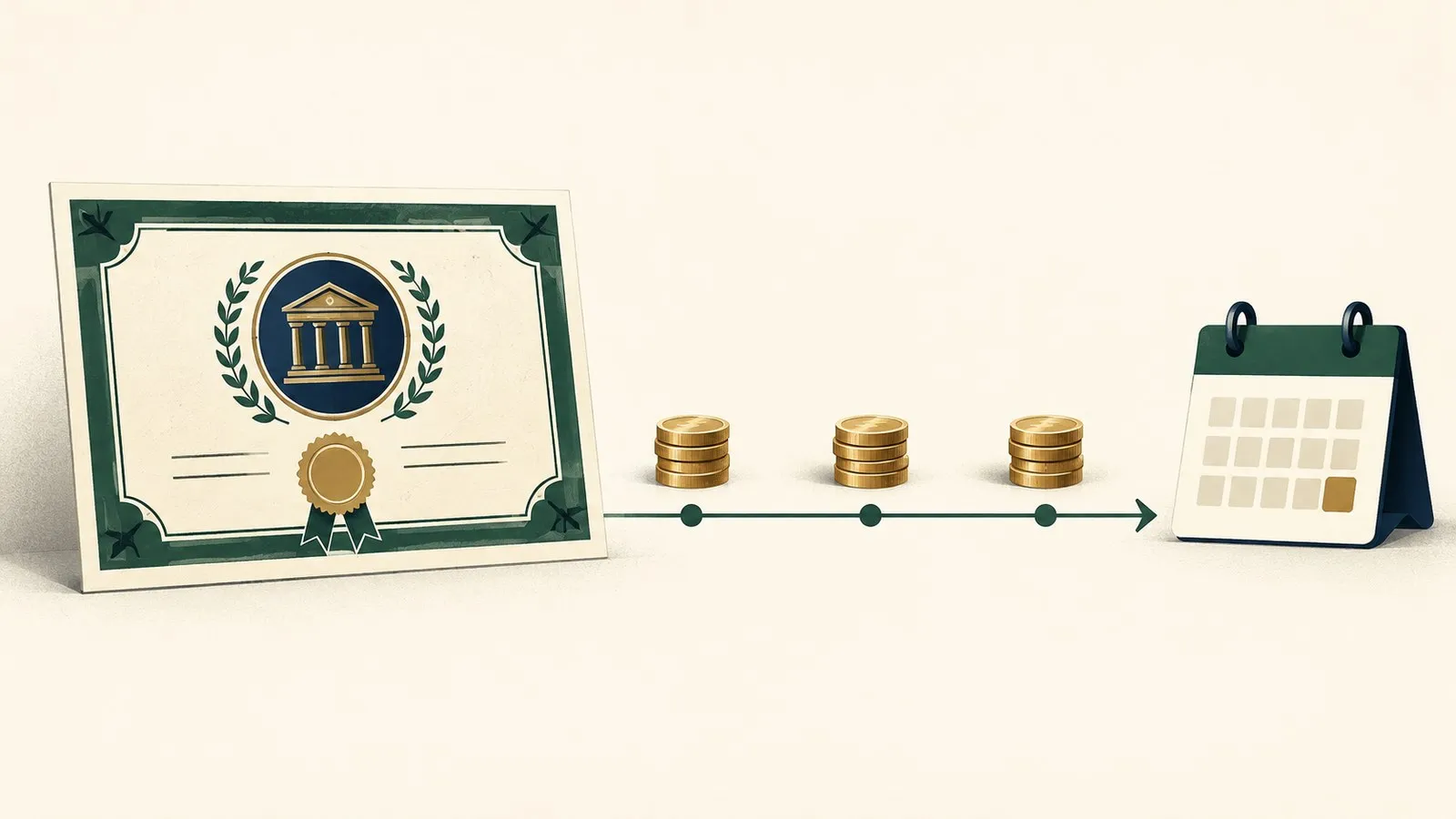
Suppose you buy a newly issued, non-callable bond for its $1,000 face value. It has a three-year term, a 4% fixed annual coupon, and pays interest every six months. Assume all payments arrive on time, with no fees, taxes, or interest earned on your cash payments.
- Annual interest: $1,000 × 4% = $40.
- Each six-month payment: $40 ÷ 2 = $20.
- Six payments over three years: 6 × $20 = $120.
- Face value repaid at maturity: $1,000, in addition to the interest.
If you hold it to maturity under those assumptions, you receive $1,120 altogether. Of that, $1,000 is repayment, not profit; the gain is $120. The 12% total gain spans three years, not one year.
Now suppose you need your money after one year, immediately after the second coupon payment. You have collected $40, but a buyer will pay only $950 for the bond.
| One-year sale outcome | Amount |
|---|---|
| Original purchase cost | $1,000 |
| Interest received | $40 |
| Sale proceeds | $950 |
| Total cash received | $990 |
| Gain or loss | −$10 |
| One-year total return | −1% |
The calculation is ($40 + $950 − $1,000) ÷ $1,000 × 100 = −1%. The coupon stayed at 4%, but the sale loss exceeded the interest you collected. This illustrates why interest income is not the same as total return. FINRA explains how to combine coupon income with gains or losses in its guide to bond yield and return.
The $950 price is an assumed sale price, not a forecast of what any particular interest-rate change would do. A real trade may also include accrued interest between coupon dates, a commission, or a dealer’s price markup or markdown. Selling immediately after a coupon payment keeps accrued interest out of this simplified example. FINRA explains bond pricing and trading costs.
Why bond prices change
For otherwise comparable fixed-rate bonds, market prices generally fall when market interest rates rise, and rise when rates fall. If new bonds offer higher rates, buyers usually need a lower price to make an older, lower-coupon bond attractive. Your fixed coupon does not automatically increase to match the new rates.
Interest rates are not the only influence. A deterioration in the issuer’s finances can lower its bond price, and limited trading can make it harder to sell at a price you expect. FINRA’s bond research guide discusses interest rates, creditworthiness, and liquidity.
Holding a conventional fixed-rate bond to maturity can avoid having to sell at a depressed market price, if the issuer makes the promised payments. It does not remove default risk or protect the purchasing power of those payments against inflation.
It also does not guarantee recovery of your purchase price. If you pay $1,050 for a bond with $1,000 face value, the scheduled maturity repayment is still $1,000. The extra $50 is a premium. A price below face value is a discount. Include that difference when evaluating the return, not just the coupon.
Coupon rate vs. current yield vs. yield to maturity
The word “yield” needs a label. These measures answer different questions:
| Measure | What it tells you | What it leaves out |
|---|---|---|
| Coupon rate | Annual coupon interest as a percentage of face value | The price you pay and any gain or loss when you sell or receive repayment |
| Current yield | Annual coupon cash divided by the current market price | The difference between price and maturity repayment, and the timing of payments |
| Yield to maturity, or YTM | The annualized rate implied by the price and scheduled coupon and maturity payments | Not a guaranteed return; taxes and brokerage costs are generally excluded |
For the example bond, annual coupon cash stays $40. At a $950 market price, current yield is $40 ÷ $950 × 100 ≈ 4.21%. That is an income-to-price ratio for that price, not the original owner’s one-year return of −1%.
YTM accounts for the scheduled repayment of face value as well as coupons. It assumes payments arrive as scheduled and the bond is held to maturity. Earning a compounded return equal to the quoted YTM also depends on reinvesting coupon payments at that rate, which may not be possible. Callable bonds need additional measures, such as yield to call. FINRA’s yield guide explains these assumptions and limitations.
If you have seen stock yields, our dividend-yield guide explains a related income-to-price ratio. Stock dividends are not the same obligation as a bond’s contractual interest payments.
Common bond types and their risks
The issuer and the terms matter more than the label “fixed income.” Common categories include:
- Government debt: issued by national governments. Creditworthiness varies by country; do not assume every government bond has the same risk.
- Corporate bonds: issued by companies. Higher-yielding, lower-rated debt generally carries greater default risk, not a free increase in income.
- Municipal bonds (US): issued by states and local public bodies. Their repayment sources and credit risks vary.
FINRA’s bond guide describes these categories and their risks. In particular, consider:
- Default risk: the issuer may fail to make interest or principal payments.
- Interest-rate risk: a change in rates can reduce market value. A measure called duration describes this sensitivity; higher-duration bonds are generally more sensitive.
- Inflation risk: fixed cash payments can buy less as prices rise.
- Call and reinvestment risk: an issuer may repay a callable bond early, leaving you to reinvest at lower rates.
- Liquidity risk: you may not find a buyer promptly at an acceptable price.
US Treasury securities: the names have specific meanings
The US Treasury issues several kinds of marketable debt. Treasury bills mature in one year or less and do not pay periodic coupons. Treasury notes are issued with terms from two to 10 years; Treasury bonds with terms of 20 or 30 years. Notes and bonds pay interest every six months. These are product definitions, not a recommendation to choose the longest term. See TreasuryDirect’s marketable-securities guide.
Treasuries are backed by the US government’s full faith and credit, but their prices can still fall before maturity. Low credit risk does not mean no interest-rate or inflation risk.
US tax rule: interest on Treasury bills, notes, and bonds is subject to federal income tax but exempt from state and local income taxes. That statement concerns interest, not every possible tax consequence of selling a security. See IRS Topic 403, Interest Received. Other bonds and account types can have different treatment; do not assume all bond income is tax-free.
Individual bonds vs. bond funds
You can hold individual bonds or buy shares in a bond mutual fund or exchange-traded fund (ETF). A fund pools investors’ money to hold multiple bonds, which can spread exposure across issuers. It also charges expenses and can lose value.
The key distinction is repayment timing. A conventional individual bond has a stated maturity payment, subject to the issuer paying. Most ongoing bond funds do not have one maturity date when you are promised your purchase amount back. They replace holdings over time, and the price of your fund shares changes. Simply waiting does not create a guaranteed repayment date. Vanguard’s explanation of bonds and bond funds describes this structural difference.
Some funds have a defined end date. For example, a Vanguard target-maturity fund prospectus specifies a planned liquidation date but says the fund does not seek to return a predetermined amount. Read the prospectus rather than treating an end date as a promise to repay your original investment.
Before buying, ask when you need the money, what could interrupt payments, whether you might need to sell early, and what costs apply. For an individual bond, check face value, price, maturity, call provisions, credit quality, and the quoted yield’s definition. For a fund, check its holdings, interest-rate sensitivity, expenses, and distribution policy. Those details tell you more than a high headline yield.
Frequently Asked Questions
Do all bonds pay regular interest?
No. Zero-coupon bonds do not make periodic interest payments. They are generally bought below face value and pay face value at maturity, assuming the issuer pays as promised. Some other bonds have floating rates rather than fixed interest payments. Read the terms instead of assuming every bond provides regular cash income.
What happens to bondholders if a company goes bankrupt?
Bondholders generally rank ahead of common shareholders, but that does not guarantee full repayment. Recovery depends on available assets, the bond's priority and security, and the bankruptcy process. You could lose some or all of your investment.
Disclaimer: This article is for educational purposes only and is not financial advice. Consider your own situation and speak with a qualified professional before making financial decisions. How we write and review content.

Written by
Research & Editorial
The FinTechAi editorial team researches, writes and fact-checks every guide on investing, crypto, AI, banking and personal finance.